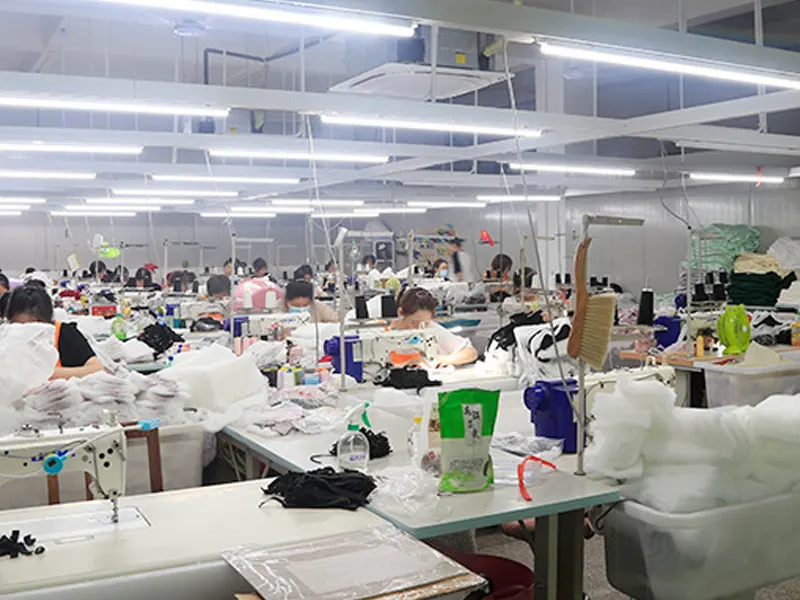


In global B2B manufacturing and procurement, the quality of latex products directly determines a brand’s market trust. Whether you are sourcing bedding (latex pillows, mattresses), industrial seals, or medical gloves, the golden ratio of Natural Latex to Synthetic Latex (such as SBR – Styrene-Butadiene Rubber) dictates the elasticity, lifespan, and odor profile of the final product.
However, driven by high margins, some factories secretly adulterate their mixtures—claiming “high-percentage natural latex” or “premium virgin synthetic blends” while actually introducing low-grade recycled regrind, excessive inorganic fillers (like calcium carbonate and talcum powder), or even crushed polyurethane foam. If this adulteration isn’t intercepted before shipment, it leads to severe quality crises down the line, such as flattening, powdering, and toxic chemical odors.
Relying solely on factory-provided third-party lab reports is a rookie mistake. As a sourcing engineer or quality assurance (QA) specialist, you must master on-site physical, chemical, and process-tracing techniques to expose these hidden practices directly on the factory floor.
Here is your comprehensive guide to identifying adulterated synthetic latex blends across four critical inspection vectors.
Table of Contents
On-Site Physical and Sensory Inspection: Look, Smell, Touch, and Tear
On the inspection floor, your hands and senses are your fastest first line of defense. High-quality blended latex retains the signature open-cell webbed structure of natural rubber. When a factory over-incorporates cheap inorganic fillers or recycled materials, the physical properties degrade noticeably.
Visual Inspection: Color and Light Reflection

Premium latex cores typically feature a soft, milky-white or slightly cream-tinted matte finish with a skin-like texture. If a factory heavily doses the blend with calcium carbonate, the core will exhibit an unnaturally chalky, stark white appearance. Under bright inspection lights, this surface looks dry and “stony.” If you closely inspect the core pins or trimmed edges, heavily filled latex will show minute flaking or white powder residue.
Olfactory Assessment: Masking Agents vs. Real Residue
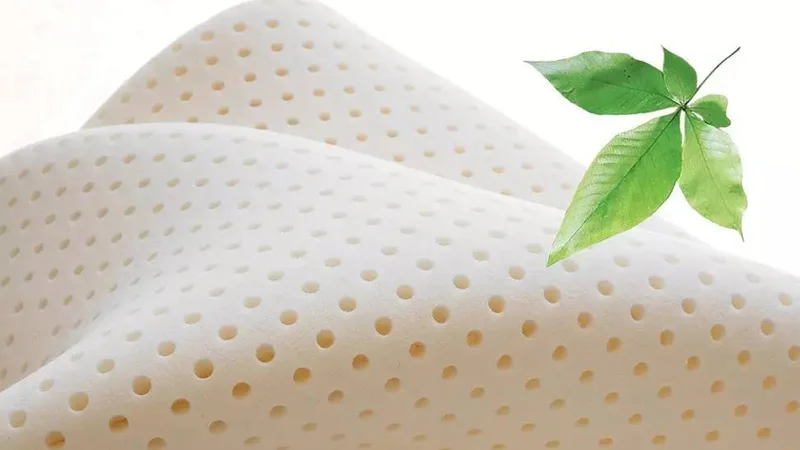
Genuine natural latex emits a mild, faint rubber smell, and even a properly cured SBR synthetic blend should smell relatively neutral or slightly sweet after thorough washing. If you open a master carton and are hit with a heavy wave of synthetic fragrance (perfume, vanilla, or intense dairy masking agents), it is an immediate red flag. Factories use these scents to hide the chemical stench of low-grade vulcanization accelerators or the oily odor of recycled components. Furthermore, any pungent ammonia or gasoline smell indicates that the factory skimped on the post-cure leaching and washing processes.
Tactile and Tear Resistance Testing
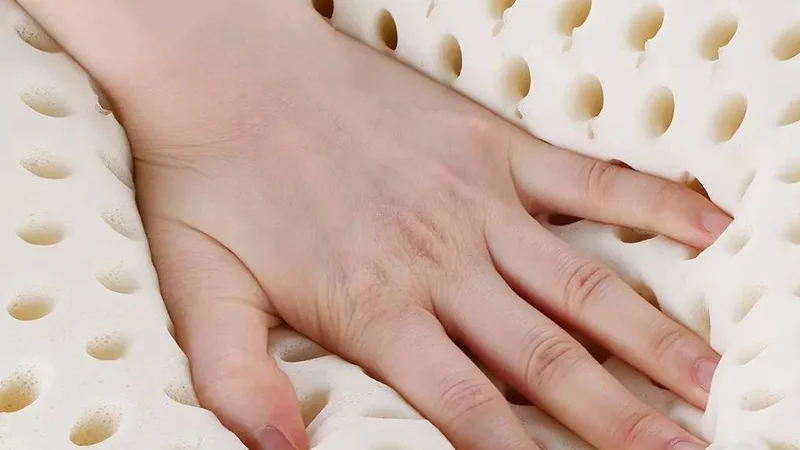
- Compression Resilience: Press your thumb firmly into the latex foam core. Premium blended latex features high resilience, snapping back instantly. If the indentation recovers sluggishly, or if the core feels stiff, dense, and lacks a delicate, springy yield, it likely contains excess filler or hidden polyurethane.
- Tear Resistance Test: Select a non-critical edge or a sample coupon and attempt to tear it by hand. Genuine latex polymer chains provide exceptional tensile strength and elongation; you will feel distinct resistance, and the torn surface will appear jagged and fibrous. Adulterated latex (especially when compromised by talcum powder) has miserable tear strength. It snaps easily with minimal effort—shearing cleanly like cold tofu, leaving a flat, powdery edge.
Production Line Audit: Tracing Batch Sheets and Pipeline Anomalies
Devious suppliers often prepare a flawless “golden sample” for pre-shipment inspection while running the actual mass production with a heavily downgraded recipe. To counter this, execute a sudden production process audit by walking straight past the showroom into the compounding and vulcanization workshops.
Reviewing the Three Core Logs
Do not rely on verbal assurances from the workshop manager. Demand to see the raw, live records for the current batch:
- Batching/Compounding Records: Check the manual logbooks or ERP digital logs positioned right by the compounding tanks. Verify the exact weight ratios of raw natural latex emulsion to synthetic SBR latex.
- Additives & Filler Requisitions: Audit the warehouse release slips for sulfur, zinc oxide, accelerators, and inorganic fillers (calcium carbonate or aluminum silicate). If the volume of filler released exceeds 3% to 5% of the total batch weight and climbs toward 15%–20%, the factory is actively manufacturing “stone rubber.”
- Total Solid Content (TSC) Logs: Legitimate raw latex compounding targets a TSC of roughly 60% to 62% before foaming. Check the internal QC logs. If the recorded TSC is suspiciously high accompanied by an elevated viscosity, it indicates they have pre-mixed heavy filler slurries into the liquid lines.
Inspecting for “Hidden Valves” and Dual Tanking
In automated Dunlop or Talalay lines, physically trace the pipelines leading to the foaming head. Unscrupulous factories occasionally configure two parallel compounding tanks with discrete, hidden bypass valves. One tank holds the pristine blend promised to the client (used during audits or sample pull-offs), while the other holds a cheap, highly adulterated slurry. Trace the lines all the way to the foaming head to ensure the material pouring into the molds stems exclusively from the validated batch tank.3. On-Site Lab Verification: Quantitative Data Over Rhetoric
When visual checks yield borderline results, leverage the factory’s internal laboratory to extract cold, hard metrics. Pull a random sample from the deep mass-production stacks and instruct the factory technician to run the following tests in your presence.
The Ash Content Test: Exposing Inorganic Fillers
This is the most definitive field method (aligned with standards like ISO 247) to trap inorganic adulteration, and any fully operational latex plant has the gear to run it.
- The Principle: Latex polymers (natural and synthetic) are organic hydrocarbon networks that completely combust and volatilize at extreme temperatures. Inorganic fillers like calcium carbonate, talc, and titanium dioxide cannot burn and remain behind as ash.
- Execution: Have the technician weigh 1 to 2 grams of the latex sample into a crucible and place it inside a muffle furnace. Burn the sample at $600^\circ\text{C}$ to $700^\circ\text{C}$ for 2 hours.
- The Verdict: High-quality, unadulterated blended latex yields a residual ash content below 3% to 5%. If the test reveals an ash residue of 10%, 15%, or more, you have undeniable, quantitative proof that the batch has been padded with mineral powders.
Density vs. Indentation Load Deflection (ILD) Deviations
Under identical foaming parameters, latex foam follows strict, predictable density profiles (e.g., $40\text{–}50\text{ kg/m}^3$ for pillows, $65\text{–}85\text{ kg/m}^3$ for mattresses).
- Execution: Cut a precise $100\times100\times100\text{ mm}$ cube from the core and calculate its exact volumetric density on a digital scale.
- The Cheat: If the density registers within specification (e.g., $75\text{ kg/m}^3$) but the foam feels completely rigid and unforgiving when compressed, or if the ILD machine reveals a starkly linear, rigid force-displacement curve rather than the classic elastic, energy-absorbing curve of true rubber, the density is artificial. It has been inflated by the high specific gravity of mineral fillers (calcium carbonate has a specific gravity of 2.7) rather than actual polymer elastomeric performance.
Destructive Dissection: Unveiling the Core Structure
To aggressively cut costs, factory managers sometimes avoid modifying the outer formulation entirely. Instead, they insert cheap polyurethane (PU) foam scrap or rebonded foam blocks directly into the core of thick molds (like mattresses) before pouring the liquid latex around them. Because molded latex forms a solid, continuous skin surface, this cannot be seen from the outside.
The Core Cut: Analyzing Geometric Consistency
Do not hesitate to execute a destructive test. Take a long, razor-sharp industrial utility knife and slice a finished mattress or pillow completely in half through its cross-section.
- Authentic Matrix: Whether produced via Dunlop or Talalay processing, the inner matrix should reveal millions of irregular, interconnected, tiny air cells (open-cell structure) resembling a fresh loaf of baked bread, complete with delicate polymer webbing.
- PU Scrap Adulteration: If the cut reveals a perfectly uniform, geometric cell layout characteristic of cheap polyfoam, distinct color variations, or fragmented bits of multi-colored bonded scrap embedded in the center, the factory has effectively stuffed the product with industrial waste.
Micro-Audit: Handheld Digital Inspection
Carry a portable, 100x USB/handheld digital microscope in your inspection kit. Focus the lens directly onto the sliced cross-sectional web:
Microscopic Guide: Authentic, clean natural/synthetic blends show smooth, uniform, continuous elastomeric strands under magnification. If the cell walls look jagged, rough, and are studded with shiny, crystalline mineral particles, or display a cracked, “dried-mud” topology, the structural polymer grid has been structurally compromised by excessive filler loading.
Summary: The On-Site Anti-Adulteration Checklist
To protect your supply chain from compromised synthetic latex blends, incorporate these three non-negotiable steps into your standard quality operating procedures:
【THE DRILL FOR ON-SITE LATEX QA】
1. Blind Sampling: Never accept pre-selected samples handed over by management. Walk the warehouse and pull random cartons directly from the production lot.
2. Destructive Sectioning: Slice samples open. Look directly at the center matrix for uniform open-cell structures and test edge tear resistance manually.
3. Lock Down Ash Testing: If performance parameters feel rigid or suspect, freeze the shipment and demand an immediate 650°C muffle furnace ash test.
By deploying this multi-layered inspection strategy, you eliminate guesswork, bypass superficial factory cover-ups, and reliably protect your brand’s product integrity.
To further strengthen your procurement safeguards and inspection protocols:
Request a complete English Quality Inspection Checklist for latex bedding with AQL limits and defect classifications.
Learn how advanced third-party labs utilize FTIR and TGA testing to calculate the precise natural-to-synthetic rubber ratio.
FAQ
What are the common signs of adulterated synthetic latex blends?
Look for atypical odors (strong chemical or petroleum-like smells), reduced elasticity, or uneven texture. Adulterated latex often fails to spring back quickly when compressed and may exhibit micro-cracking or tearing under light stretching.
Can I use a simple on-site test to detect latex adulteration?
Yes. Perform a manual “stretch and rebound” test or a density check. Pure or high-quality natural/synthetic blends have a specific weight-to-volume ratio. If the foam feels unusually heavy or lacks resilience, filler materials might be present.
Why do factories adulterate synthetic latex with cheap fillers?
Suppliers often introduce cheap mineral fillers (like calcium carbonate) or excessive low-grade polymers to artificially increase the product’s weight and volume, significantly cutting manufacturing costs at the expense of durability.
How does adulterated latex impact the final product’s lifespan?
Adulteration accelerates the degradation of the foam. Products like pillows or mattresses will sag prematurely, lose their supportive contouring properties, and break down into powdery residue much faster than standard blends.
What advanced tools should inspectors use for verification?
For precise verification, inspectors can take samples for laboratory testing, specifically using FTIR (Fourier-Transform Infrared Spectroscopy) or TGA (Thermogravimetric Analysis) to accurately map the polymer composition.
How can I protect my supply chain from latex fraud?
Establish a strict Quality Control (QC) checklist, require suppliers to provide certified Material Safety Data Sheets (MSDS), and conduct unannounced factory audits paired with random third-party laboratory testing.